
 UAE
UAE
 Qatar
Qatar
 Pakistan
 KSA
KSA
 Oman
Oman
 Kuwait
 Bahrain
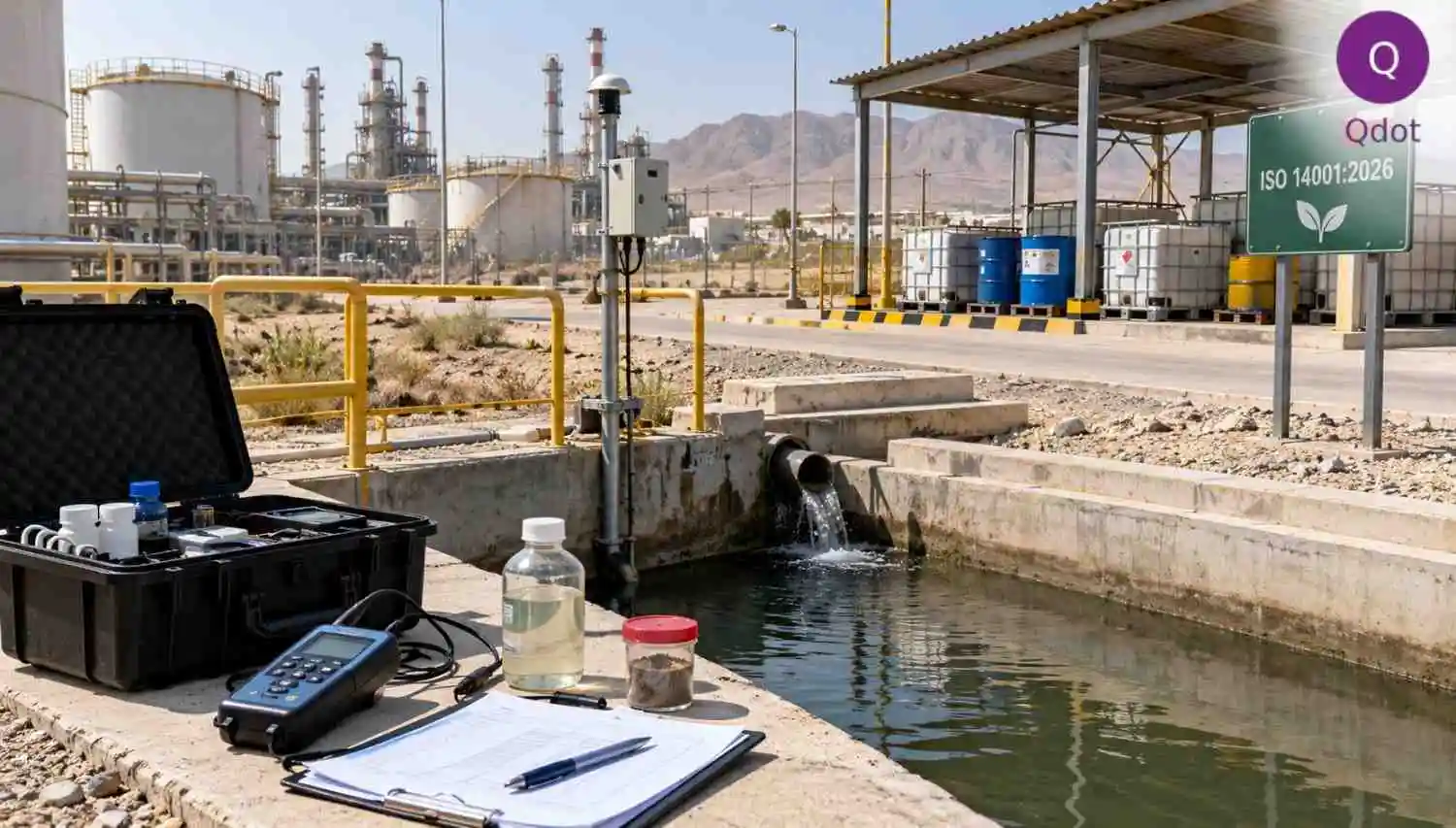
A certificate that reads ISO 14001:2015 now comes with a deadline. Accredited certification to that edition ends on 30 April 2029. That date is the finish line of a three-year transition that started when ISO released ISO 14001:2026 on 15 April 2026.
Three years can look generous until you list the work: a gap review, document changes, an internal audit, a management review, and an opening in your certification body’s schedule.
This guide is for organizations that already hold an ISO 14001:2015 certificate and need a workable plan for ISO 14001:2026 in Oman. It explains what changed, where Oman sites should look first, and gives a 12-step roadmap, a readiness checklist and the timing questions to raise with your certification body. It skips the basics of ISO 14001.
Haven’t certified yet? Then there is nothing to transition. You would build to the 2026 edition from the start, and our ISO 14001 consultancy in Oman page is the right place to begin.
What is ISO 14001:2026?
ISO 14001:2026 is the fourth edition of the international standard for environmental management systems (EMS). In ISO’s catalogue it appears as published in April 2026, with ISO 14001:2015 and its 2024 climate change amendment both withdrawn in its favour.
It updates the existing standard instead of starting over, so the basic structure will feel familiar. Global ACI, the accreditation body that issued the transition rules, calls the overall changes minimal. It also points out that the effect varies between organizations. Each certified organization has to judge what the changes mean for its own context and system.
Two quick reminders. ISO itself does not certify anyone. Independent certification bodies do that. And when you describe your certification, include the year: write certified to ISO 14001:2026 rather than only ISO 14001.
What changed in the 2026 edition?
Every change below is confirmed by ISO, by Global ACI’s transition document, or by certification bodies that have summarized the published edition. Anything found only in draft-stage material has been left out.
| Clause | Area | What changed |
|---|---|---|
| 4.1, 4.2 | Environmental conditions | The context and interested-party reviews now point to a broader list of conditions: pollution, availability of natural resources, climate change, biodiversity and ecosystem health. The 2024 climate change amendment is folded into the main text. |
| 4.3, 6.1.2 | Life cycle perspective | Life cycle thinking carries more weight, from raw material to final disposal, both when setting scope and when identifying aspects. |
| 5 | Leadership | Top management owns environmental performance more visibly, and objectives need to line up with the organization’s strategic direction. |
| 6.1.2 | Operating conditions | Emergency situations are now assessed on their own, apart from abnormal operations. |
| 6.1.1, 6.1.4 | Risks and opportunities | The requirements were reorganized and made clearer. Risks and opportunities have a dedicated sub-clause, 6.1.4. |
| 6.3 | Planning of changes | A new clause. When a change affects or could affect the EMS, it has to be carried out in a planned way. |
| 8.1 | External providers | The term outsourced processes gives way to externally provided processes, products and services, which is wider in scope. |
| 9.2 | Internal audit | Each audit needs defined objectives. The audit programme, and evidence of audits and their results, must be available as documented information. |
| 9.3 | Management review | Now divided into 9.3.1 General, 9.3.2 Inputs and 9.3.3 Results. |
| Throughout | Terms and wording | Aligned with the updated Harmonized Structure used across ISO standards. The standard now uses “available” as its wording for documented information, and several terms changed, such as “meet compliance obligations”. |
| Annex A | Guidance | Expanded in several places, including context, risks and opportunities, life cycle perspective and the link to strategy. |
ISO’s own summary of the edition puts climate change, biodiversity and resource efficiency up front, together with leadership and governance. In day-to-day terms that means clearer wording, more guidance and some reorganized requirements, not new numeric targets. The standard still sets no specific environmental performance criteria. Deciding what matters for your organization is your job, and so is showing how you decided.
What does the change mean for Oman organizations?
The standard reads the same everywhere, but your risks don’t. Three things deserve extra attention in Oman.
Environmental conditions are local. The 2026 wording asks about conditions your organization affects, and conditions that can affect you. In Oman that could mean intense summer heat, limited water, dust, flash floods, cyclone exposure along the coast, or sites near the sea, wadis or protected areas. Don’t paste in a generic list from a template. For each site, decide which conditions apply and note the reason.
Contractors carry part of your environmental risk. If your sites rely on subcontractors, labour suppliers, haulage or hired equipment, the shift from outsourced work to externally provided processes, products and services affects you. Each of these needs a defined level of control or influence, not an assumed one.
Permits and client terms are compliance obligations. When a site holds an environmental permit from the Environment Authority, the permit conditions are part of your obligations, including monitoring reports and any other duties the permit sets. So are client and contract requirements you agreed to meet. Your register should make clear which are legal and which you took on voluntarily.
Where to look first, by sector
| Sector | Look first at |
|---|---|
| Manufacturing | Subcontracted processes such as coating or heat treatment, chemicals and process waste, and changes to lines or materials (clause 6.3) |
| Construction | Dust and water use, waste routes, subcontractor control, material and haulage suppliers, and changes as the project moves between phases |
| Oil and gas | Spill, leak and fire scenarios assessed in their own right, contractor control, and changes to plant or procedures |
| Energy | Site and ecosystem effects of new capacity, change planning for upgrades and shutdowns, and contractor control |
| Logistics | Fleet fuel use, subcontracted transport, fuel storage and yard emergencies, and depot or route changes |
| Food | Water and energy use, packaging and food waste, supplier sourcing, refrigerants and cold chain energy |
| Hospitality | Water and energy in hot weather, waste, outsourced laundry, landscaping and pest control, nearby beach or marine areas, and building works |
| Other services | Energy, waste and travel, outsourced facility services, and new sites or systems |
Practical ISO 14001:2026 transition roadmap
There are twelve steps, taken in order. Steps 1 to 7 are reviews, steps 8 and 9 are updates, and steps 10 to 12 are where you prove readiness.
Phase 1: Review
1. Review your existing EMS. Begin by getting a copy of the standard from the ISO store or an authorized national distributor. Then pull together your scope, context analysis, aspects register, compliance register, risk and opportunity records, objectives, operational controls, latest internal audit report, latest management review, and the most recent audit report from your certification body. Read them against the new standard before changing anything. Jumping straight into rewriting often fixes the wrong things.
2. Identify changes and gaps. Go through the changes table and label each line as covered, partly covered or missing. Every gap gets an owner and a due date, and one page is enough to hold the list. Annex A was expanded in this edition, so lean on it whenever a requirement isn’t clear.
3. Review environmental aspects, impacts and conditions. Run two checks. First, take the example conditions in the context requirement (pollution, natural resources, climate change, biodiversity and ecosystem health) and note which affect each site and which the site affects. Second, test your aspects register. Does it reach beyond your boundary into supply, delivery, use and disposal wherever you have control or influence? Are emergencies assessed separately from abnormal operations? Re-rate significance for anything you add.
Example: a ready-mix plant may already track dust and water use. It should now also look at where its aggregates come from and what would happen in a fuel or chemical spill.
4. Review risks and opportunities. Every risk and opportunity should connect to a condition, an aspect or a compliance obligation. Cover opportunities as well as risks.
Example: limited water in peak summer is a risk for a food plant. Recycling water, where permitted, is the matching opportunity, and it should turn into an action and an objective.
5. Review compliance obligations. Refresh your register with permit conditions, monitoring and reporting duties, other legal requirements, client and contract terms, industrial estate or free zone rules, and any voluntary commitments you decided to meet. Mark each item as legal or voluntary, then confirm you have evaluated compliance against every one. If you have made public environmental or climate statements, check that your EMS records back them up.
6. Review objectives and performance measures. Each objective needs a measure, a baseline, an owner, a deadline and a progress record. The standard sets no performance levels, yet ISO leans harder on results you can demonstrate. Slogans like “reduce our footprint” should become a number or a clear milestone.
Examples: litres of water per tonne produced or per guest night, kWh per unit of output, tonnes of waste sent to licensed recyclers, contractor environmental audits completed.
7. Check operational controls and externally provided processes. List everything you buy in that touches an environmental aspect: subcontractors, transport, waste collectors, laundry, landscaping, maintenance, hired equipment and key material suppliers. The 2026 text reaches products and services too, not just outsourced work. For each item, decide what control or influence you hold and record it, for instance through a contract clause, a site induction, a permit check or an inspection.
Example: if a contractor takes away your waste, keep a copy of the permits they need to transport and dispose of it.
Phase 2: Update
8. Update relevant documents and processes. Work from the gap list, not from a blank page. You don’t have to rename or renumber documents to mirror the standard, as long as every requirement is met. Typical updates include:
- A change-planning step for clause 6.3. If your site already runs a management-of-change process for safety, add an environmental check to it instead of creating a second system. Triggers include new equipment, a new area or site, a process or material change, and a new supplier or contractor.
- Audit programme and plan templates that now carry audit objectives.
- A management review agenda that follows the new structure.
- Aspects and risk templates that cover emergencies and life cycle stages.
- Contractor and supplier control documents, widened to cover products and services.
- Cross-references to clause numbers that moved in clauses 6, 9 and 10.
9. Build employee awareness. Skip the one big training session. Run short briefings for each role:
- Top management: leadership, context, objectives and strategy, change planning.
- Managers and process owners: aspects, objectives, change planning.
- Procurement and contracts staff: externally provided processes, products and services.
- Site supervisors and subcontractor foremen: operational controls and emergency response.
- Internal auditors: the 2026 requirements and audit objectives.
Keep attendance records. They prove the awareness work took place.
Phase 3: Prove
10. Conduct an internal audit. Audit the whole system against ISO 14001:2026, not just the clauses that changed. Set audit objectives, update the programme, and cover contractor-heavy and remote sites as well as the head office. Close the findings before your certification body arrives.
11. Complete a management review. Hold it after the internal audit so the results feed straight in. Follow the new structure of general, inputs and results. Cover changes in context and environmental conditions, progress on gaps, objectives, compliance status, audit results and resources. Record the decisions clearly.
12. Prepare for the transition audit. Agree the plan with your certification body, using the questions in the next section. The audit looks at the changed requirements, changes in your context and any other changes your system needs. Assemble a short “what changed” pack: the closed gap list, updated documents, the internal audit report and the management review minutes. Brief the people who will be interviewed.
Transition readiness checklist
Tick only what you can show on the day.
| ☐ | Area | Be able to show |
|---|---|---|
| ☐ | Gap analysis | A dated gap list with owners, plus the items already closed |
| ☐ | Context | The named environmental conditions reviewed, interested-party expectations recorded, and a clear decision on what applies and why |
| ☐ | Aspects | Life cycle stages you control or influence covered, with emergencies assessed apart from abnormal operations |
| ☐ | Risks and opportunities | Each one linked to a condition, aspect or obligation, with actions attached |
| ☐ | Compliance | Permit conditions, reporting duties and client terms listed, with records of your compliance evaluation |
| ☐ | Objectives | Measures, baselines, owners and progress records |
| ☐ | Change planning | A documented method, and a recent change that went through it |
| ☐ | External providers | Relevant providers, products and services listed, with the controls you apply |
| ☐ | Documents | Wording updated where needed, and documented information available when needed |
| ☐ | Awareness | Briefing records for each role |
| ☐ | Internal audit | Objectives, programme and a report against the 2026 requirements, with findings closed |
| ☐ | Management review | Minutes in the new structure, with decisions recorded |
| ☐ | Certification body | Written confirmation of audit type, date and scope |
When should organizations start preparing?
Now, beginning with the gap review. The rest depends on your certificate cycle and on when your certification body is ready. These are the confirmed dates.
| Date | What happens |
|---|---|
| 15 April 2026 | ISO releases ISO 14001:2026. |
| 31 October 2026 | Accreditation bodies must be set up to assess against the 2026 edition. |
| 31 January 2027 | Certification bodies submit their transition declaration to their accreditation body. |
| 30 April 2027 | Accreditation bodies finish deciding on the transition of certification bodies. |
| 31 October 2027 | From this date, new and initial accredited certificates can only be to ISO 14001:2026. |
| 30 April 2029 | The transition closes. Certified clients must be transitioned and have their certificate issued, and accredited ISO 14001:2015 certification stops being valid. |
Five questions to put to your certification body
- When will your accreditation to issue ISO 14001:2026 certificates come through? An accredited 2026 certificate can only be issued once the certification body’s own accreditation has been moved across.
- Can we transition at our next surveillance or recertification audit, or do you want a separate audit? Either route is permitted.
- How much audit time do you expect? The certification body decides, depending on how much your system changes and whether the transition shares an audit with something else.
- Do you set your own cut-off dates? Some certification bodies stop auditing to the 2015 edition ahead of the global end date.
- Is our certificate accredited, and which rules apply to it? Global ACI’s transition rules apply to accredited certification bodies and their accreditation bodies.
A timing note: the 30 April 2029 date applies to the certificate being issued, not only to the audit. Findings take time to close, so avoid scheduling the audit in the last few months.
Here is a pace we would suggest. Finish the gap review and speak to your certification body before the end of 2026. Update documents and run the awareness briefings in the first half of 2027. Then book the internal audit, management review and transition audit once your certification body is ready, leaving a buffer before April 2029. If your cycle allows, let the transition share a surveillance or recertification audit.
ISO 14001:2026 transition-readiness review
Rewriting documents without knowing what actually needs to change wastes weeks. Qdot’s transition-readiness review checks your current EMS against ISO 14001:2026 and turns the findings into a short, prioritized action list.
The review covers:
- Context, aspects, and risk and opportunity records, measured against the 2026 changes
- Compliance obligations, objectives and performance measures
- Contractor and supplier controls
- Change planning, internal audit and management review
- Your certificate cycle, and the points to settle with your certification body
Qdot is a consultancy and implementation support provider. We do not issue ISO certificates. Your certification body decides on certification and carries out the transition audit.
Request an ISO 14001:2026 transition-readiness review. Keep your certificate expiry date, EMS scope and latest internal audit report handy when you get in touch.
FAQs
Yes, for now. Accredited 2015 certification stays valid until 30 April 2029 at the latest. If you decide not to transition, your certification body may keep auditing you against the 2015 edition until then, but the certification cannot continue beyond that date.
Not always. It can be done as part of a surveillance audit, as part of a recertification audit, or as a standalone audit. Your certification body may carry it out remotely if the audit objectives can still be met.
The standard sets no specific environmental performance criteria. It expects you to consider the relevant environmental conditions, including climate change and biodiversity, in your context and interested-party analysis, and to act where they matter to your EMS. If a condition doesn’t apply to you, be ready to explain how you reached that decision.
Not necessarily. ISO 14001 has never demanded a manual or a fixed document layout. Keep what works, and update it where requirements changed: change planning, external providers, audit objectives, the management review structure and the wording around documented information.
We would advise against it. From 31 October 2027, new accredited certifications must be to ISO 14001:2026. Before that date a certification body may still audit you against either edition, but a 2015 certificate would have to be transitioned again before April 2029. If you are starting now, build to the 2026 edition.
Often you can update the shared parts once. ISO 14001:2026 follows ISO’s Harmonized Structure, the framework used by other ISO management system standards, so internal audit, management review and document control can often be handled in a single pass. Check each change against each standard’s own requirements. Qdot’s ISO consultancy in Oman team can review the shared procedures together.