
 UAE
 Qatar
 Pakistan
 KSA
 Oman
 Kuwait
 Bahrain
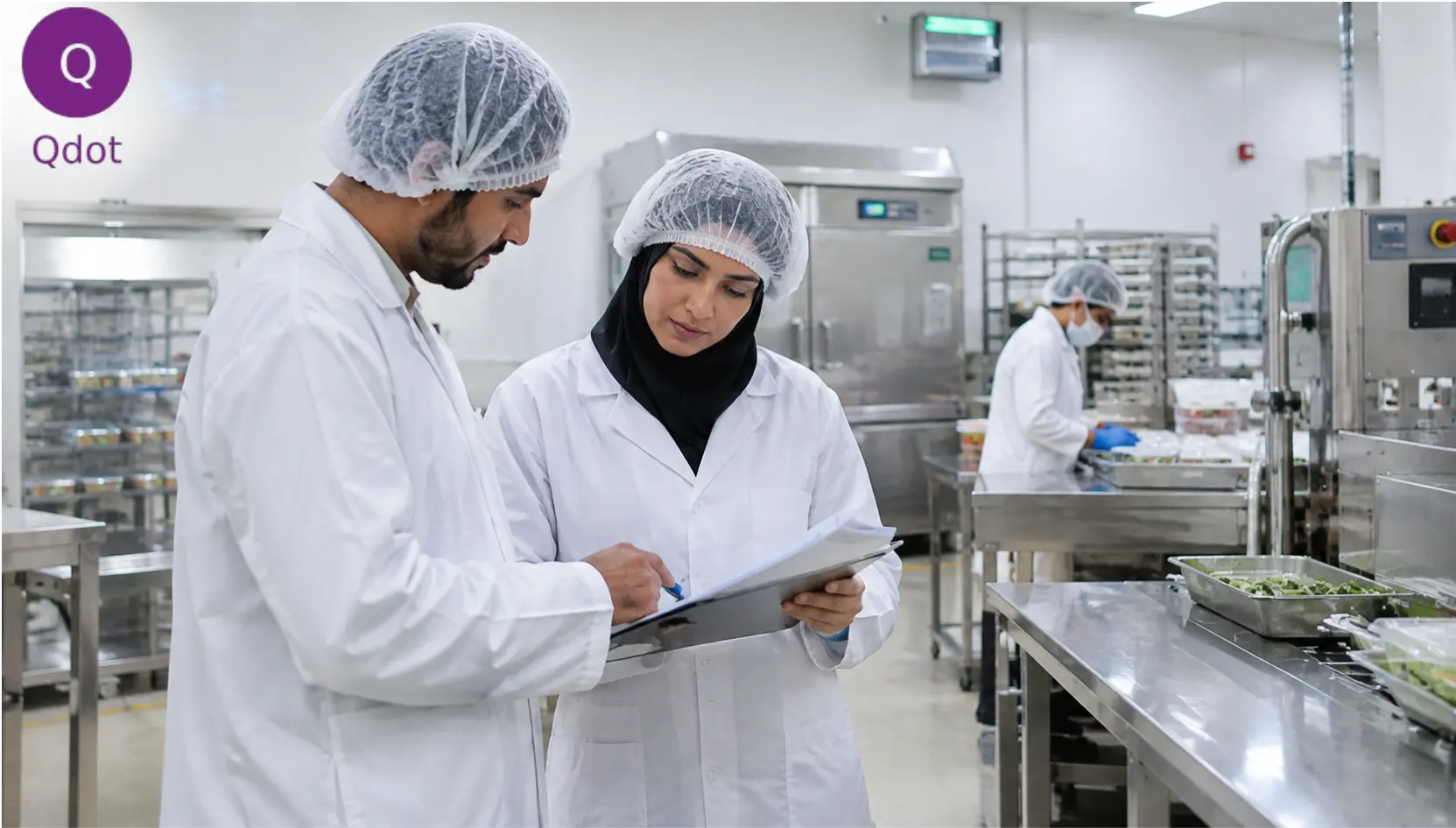
Qdot provides professional ISO 22000 Consultancy in Oman for organizations involved directly or indirectly in the food chain. Our ISO 22000 consultants help food manufacturers, processors, caterers, restaurants, hotels, cold stores, logistics companies, packaging and ingredient suppliers, seafood businesses and distributors establish an effective FSMS.
For organizations seeking ISO 22000 Certification in Oman, Qdot provides practical implementation support from initial assessment to certification-audit readiness, and remains available for surveillance audits and continual improvement afterwards.
Quick answer: ISO 22000 consultancy helps food-chain organizations design, implement and maintain a Food Safety Management System (FSMS) that meets ISO 22000. A consultant identifies gaps, builds hazard controls, procedures and records, trains staff and tests the system through internal audit and management review, so the organization is ready for an independent certification audit.
Planning ISO 22000 Certification in Oman?
Speak with Qdot about your food-chain activity, products, processes, number of sites, existing HACCP or food-safety controls and target certification timeline.
What Is ISO 22000?
ISO 22000 is the international standard for Food Safety Management Systems. It combines leadership commitment, risk-based planning and interactive communication along the food chain with prerequisite programs and HACCP-based hazard control, then adds verification, management review and continual improvement. PRPs set the basic hygiene and operating conditions, while OPRPs and CCPs are the hazard-control measures selected through hazard analysis.
ISO 22000:2018 remains the current published Food Safety Management System requirements standard, with Amendment 1:2024 addressing climate-action considerations. A further revision is under development.
ISO 22000 Consultancy and Certification: What's the Difference?
Qdot provides consultancy, implementation, training, internal-audit and certification-readiness support. The ISO 22000 certificate itself is issued by an independent certification body after the organization completes the required certification audit and the body makes its certification decision. Because that decision rests with the certification body, no consultant can guarantee the result.
Where required, Qdot can help clients understand certification-body options, prepare for audit activities and coordinate the process, while keeping consultancy and certification independent.
Why Food Businesses in Oman Implement ISO 22000
- Establish a systematic, risk-based approach to identifying and controlling food-safety hazards.
- Strengthen food-safety responsibilities, communication and accountability across departments.
- Improve prerequisite programs, hygiene controls and operational discipline.
- Improve supplier, ingredient, packaging and outsourced-service controls.
- Strengthen traceability, withdrawal and recall preparedness.
- Improve monitoring, verification, validation and corrective-action processes.
- Support customer, tender and supply-chain requirements where ISO 22000 certification is requested.
- Create consistent controls across multiple kitchens, factories, warehouses or branches.
- Integrate food-safety management with ISO 9001 or other management systems where useful.
Our ISO 22000 Consultancy Services in Oman
Deliverables depend on the agreed scope, sites and current system. Not every project includes every item below. We start from what you already have, such as HACCP plans, GMP records, procedures, supplier approvals and audit reports, so effort goes into real gaps rather than rewriting documents that already work.
- Gap assessment and implementation plan: documented findings against ISO 22000 and a prioritized action plan.
- FSMS scope, policy and process maps: defined certification scope, food-safety policy, measurable objectives and verified process-flow diagrams.
- PRP assessment and action plan: review of hygiene, sanitation, pest control, maintenance, zoning, waste, utilities, storage and allergen controls.
- Hazard analysis and control measures: biological, chemical, physical and allergen hazards, with control measures, OPRPs and CCPs (critical limits or action criteria) where applicable, plus validation and verification planning.
- FSMS documentation and monitoring records: procedures, work instructions, forms and registers matched to your operations.
- Supplier, traceability and recall arrangements: supplier and outsourced-process control, traceability, withdrawal and recall, emergency preparedness and food-safety communication.
- Internal audit and management review support: audit planning, nonconformity and root-cause support, and management-review preparation.
- Certification-readiness review: evidence review and gap closure before the independent audit.
ISO 22000 Implementation Process in Oman
A typical FSMS project follows this sequence, adjusted to your scope and starting point:
- Initial consultation and FSMS scope: we review your food-chain role, products, processes, sites, customers, applicable requirements and existing HACCP/GMP controls.
- Gap analysis: current practices are compared with ISO 22000 to set implementation priorities.
- Process mapping: flows from receiving to dispatch are mapped and checked against actual operations.
- Prerequisite program review: the fundamental hygiene and operating conditions are reviewed and strengthened where needed.
- Hazard analysis and control measures: the food-safety team uses product, process and intended-use information to identify hazards, assess significance and select control measures, categorized as OPRPs or CCPs where required.
- FSMS documentation: policies, procedures, plans, forms and monitoring records are developed or improved.
- Training and awareness: employees learn their hazard-control, monitoring and record-keeping responsibilities.
- Practical implementation: the organization operates the system and builds evidence through monitoring, supplier controls, sanitation records, traceability tests and corrective actions.
- Validation and verification: validation shows that selected control measures can achieve the intended control; verification confirms that controls and the FSMS are implemented and working as intended.
- Internal audit: conformity and implementation are evaluated before the external audit.
- Management review: top management reviews performance, audit results, incidents, complaints, resources and improvement opportunities.
- Certification audit readiness: evidence, open issues and food-safety team preparedness are reviewed before the certification body audit.
- Post-certification support: continues after the certificate is issued, as described below.
Responsibility is shared: Qdot guides the assessment, documentation, training and audits, while your food-safety team operates the controls and keeps the records the certification body will review.
ISO 22000 and Other Food Safety Standards
HACCP is a hazard-control methodology, while GMP and prerequisite programs set the basic hygienic conditions for safe food handling. ISO 22000 places both inside a certifiable management system. FSSC 22000 is a separate scheme that builds on ISO 22000 with additional scheme requirements. The right choice depends on customer expectations, sector and certification objective. Unsure which suits yours? Read ISO 22000 vs HACCP in Oman.
ISO 22000 Certification in Oman: Process, Cost and Timeline
Once the FSMS is operating and records show the controls are working, the organization can apply to an independent certification body. The exact process depends on the body, certification scope, number of sites and complexity of the food-chain activity.
- Confirm the certification scope and applicable sites.
- Select an independent certification body. Compare its accreditation, coverage of your food category, auditor availability in Oman and acceptance by your customers.
- Complete Stage 1, the initial documentation and readiness review, where applicable.
- Resolve any issues raised before the main audit.
- Complete the Stage 2 audit, which assesses on-site implementation and effectiveness, and close any nonconformities within the required timeframe.
- Receive certification after the body's review and decision, then maintain the FSMS for surveillance audits and recertification.
What affects cost and timeline. Consultancy cost and project duration depend on scope, number of sites, process complexity, existing controls, training needs and how quickly evidence is generated. Certification-body fees are separate and depend on that body's audit requirements. A gap analysis gives a realistic basis for planning; Qdot does not quote fixed prices or periods without reviewing your scope.
Local approvals are separate. Food businesses in Oman must identify the food-safety requirements that apply to their products, activities and operating locations. For example, seafood-processing establishments and businesses registering food products may need specific approvals and supporting records from the relevant authorities, such as food-product registration or a quality control certificate for fish-processing plants. ISO 22000 can help organize food-safety controls and compliance evidence, but independent ISO certification does not replace these approvals.
ISO 22000 Consultancy Across Oman
Qdot supports food-chain organizations across Oman, with onsite, remote or hybrid consultancy depending on scope and location. Our coverage includes food manufacturers, beverage producers, packaging suppliers and warehouses in Muscat and Rusayl; processors, cold stores, import-export companies and logistics operators in Sohar; seafood, hospitality, cold-chain and free-zone food businesses in Salalah; and fisheries, cold-chain and catering operations in Duqm. We also support food businesses in Nizwa, Sur, Barka, Al Buraimi, Ibri, Samail and Musandam, and in industrial cities, free zones and economic zones nationwide. Multi-site organizations can be supported with consistent controls across locations, and we can advise which sites to include in the certification scope.
ISO 22000 for Food Businesses and Industries in Oman
ISO 22000 applies to any organization in the food chain, from manufacturers, processors and caterers to cold stores, importers, packaging and ingredient suppliers. The focus differs by activity:
| Food-Sector Activity | Typical ISO 22000 Focus |
|---|---|
| Food and beverage manufacturing in Oman | Hazard analysis, PRPs, supplier and process controls, OPRPs/CCPs, sanitation, traceability, monitoring and verification. |
| Fisheries and seafood processing | Raw-material and temperature control, contamination hazards, handling, cold chain, traceability and export-supporting food-safety controls. |
| Tourism, hospitality and catering | Receiving, storage, preparation, cooking, cooling, holding, service, allergen control, cleaning, personnel hygiene and supplier approval. |
| Central Kitchens & Cloud Kitchens | High-volume preparation, zoning, allergen and cross-contamination control, time/temperature management, dispatch and multi-site consistency. |
| Cold Storage & Food Logistics | Temperature control, segregation, storage conditions, vehicle hygiene, traceability, emergency response and monitoring. |
| Dairy & Beverage | Raw-material quality, microbiological hazards, cleaning, process controls, packaging, storage, traceability and verification. |
| Bakeries & Confectionery | Ingredient and allergen controls, hygiene, baking and process controls, packaging, storage and traceability. |
| Food Importers & Distributors | Supplier approval, product specifications, storage, traceability, withdrawal/recall and customer communication. |
| Food Packaging Suppliers | Food-contact risks, contamination control, supplier assurance, production hygiene and traceability. |
| Ingredient & Raw-Material Suppliers | Supplier controls, specifications, contamination hazards, storage, transport, traceability and communication across the food chain. |
ISO 22000 can also be scaled to small and medium food businesses. Smaller organizations do not need excess paperwork; they need clear hazard controls, practical records, trained staff and management oversight. Qdot tailors the approach for small restaurants, caterers, bakeries, traders, warehouses and growing manufacturers.
ISO 22000 Training and Ongoing Support
Training. Qdot can support training aligned with your ISO 22000 project, including ISO 22000 awareness training for management and staff and ISO 22000 internal auditor training for your audit team. Food-safety team workshops and role-specific operational training can be built into the project.
After certification. The FSMS must keep operating. Qdot can support surveillance audits, periodic internal audits, hazard-plan updates after changes, traceability and recall tests, corrective actions, supplier monitoring and management review.
Why Choose Qdot for ISO 22000 Consultancy?
- Practical Food Safety Management Systems designed around your real food-chain processes.
- End-to-end support from gap analysis to certification-audit readiness.
- Documentation built around your scope rather than generic templates.
- Support for manufacturing, catering, hospitality, logistics, cold-chain, seafood, packaging and distribution businesses, at single or multiple sites.
- Integration with HACCP, GMP, ISO 9001 and related frameworks where appropriate.
- Onsite, remote or hybrid delivery depending on scope and location.
- Clear separation between consultancy and independent certification.
See what clients say about Qdot on our Google reviews page.
Start Your ISO 22000 Project in Oman
If your organization is planning ISO 22000 certification, Qdot can assess your current food-safety system, define the certification scope, strengthen prerequisite programs, complete hazard analysis, develop practical documentation, train your team and prepare you for the independent certification audit.
Send us your food-chain activity, products, locations and target certification date, and we will recommend a practical implementation approach and quotation. Sharing existing HACCP or GMP documents helps us scope the work accurately.
FAQs - ISO 22000 in Oman
No. Qdot provides consultancy and certification-readiness support. The certificate is issued by an independent certification body after its audit and certification decision.
ISO 22000:2018 is the current published edition, amended by Amendment 1:2024 on climate action. A further revision is under development but has not been published.
ISO 22000 is a voluntary standard, not a blanket legal requirement for every food business. Customers or tenders may require it, and licences, product registration and other approvals apply separately. Check the requirements that apply to your activity with the relevant authority.
Yes. Existing HACCP and GMP controls are a strong foundation. Qdot identifies the additional management-system requirements and plans the remaining work toward certification readiness.
There is no fixed period. It depends on your starting point, size and process complexity, and on how quickly the system is implemented and records are generated. A gap analysis gives the most reliable basis for planning.
Consultancy fees depend on your scope and the support required, while certification-body fees are quoted separately by the body you choose. Qdot provides a quotation after reviewing your scope and does not publish fixed prices.
Please share your food-chain activity, main products, number of sites and employees, existing HACCP, GMP or ISO documents, customer requirements and target certification date. Existing audit reports or process-flow diagrams help but are not required to start.