
 UAE
UAE
 Qatar
Qatar
 Pakistan
 KSA
KSA
 Oman
Oman
 Kuwait
 Bahrain
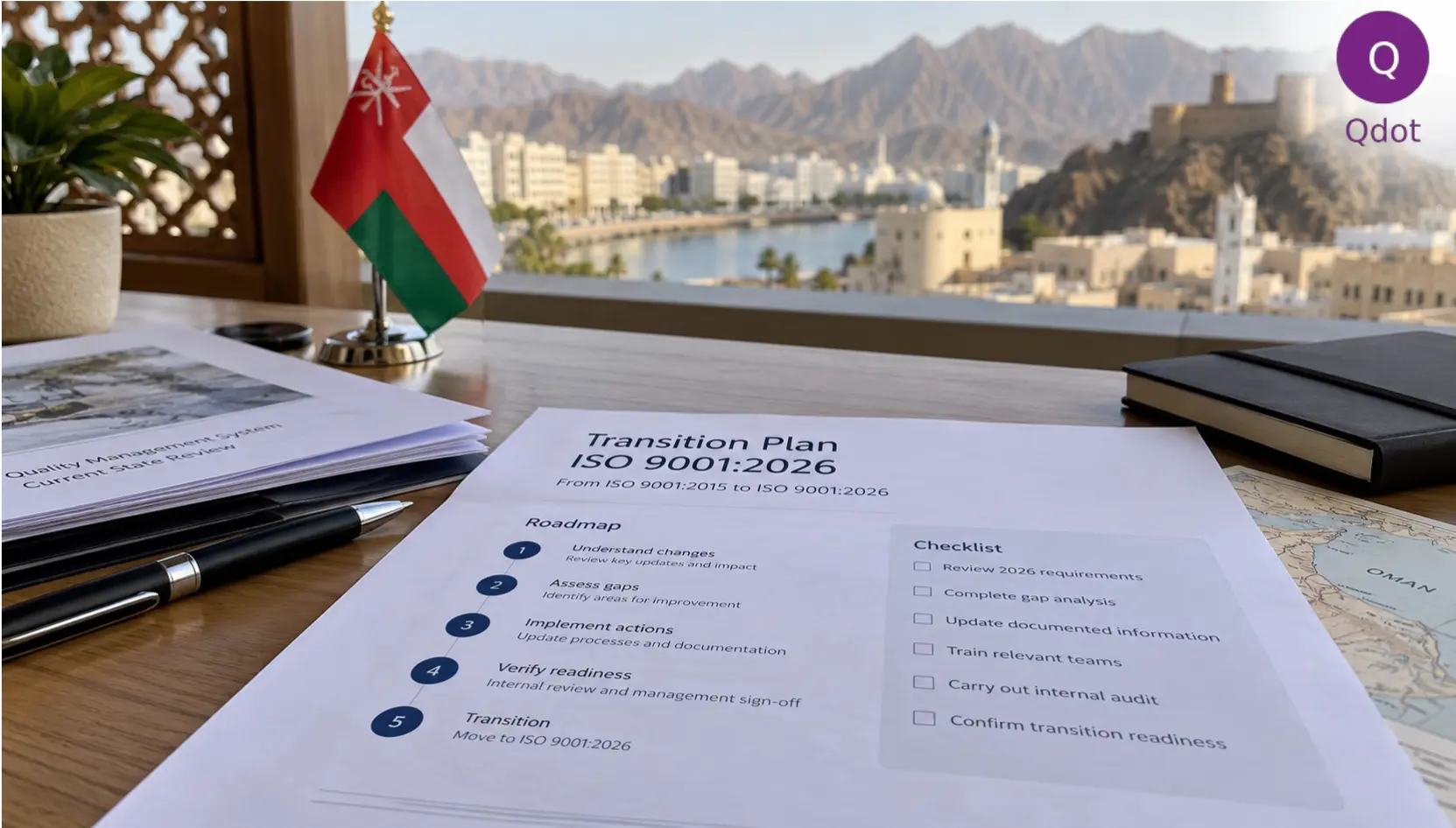
ISO 9001:2026 is now officially published. Here's what has actually changed, what it means for organizations in Oman, and a practical roadmap for moving from ISO 9001:2015 without disrupting daily operations.
ISO 9001:2026 is no longer a draft or a "coming soon" standard. Organizations across Oman that hold ISO 9001:2015 certification now need a plan — not a full QMS rebuild, but a structured, proportionate transition.
This article covers what has actually changed, what it means for organizations operating in Oman, and a step-by-step roadmap you can use to move from ISO 9001:2015 to ISO 9001:2026 without disrupting daily operations.
Is ISO 9001:2026 Officially Published?
Yes. On 16 September 2026, ISO's Technical Committee ISO/TC 176/SC 2 published the final version of the international standard for quality management. This is the sixth edition, and it formally replaces ISO 9001:2015.
That matters for planning purposes. Anything you read before this date describing "expected changes" based on the Draft International Standard (DIS) or Final Draft (FDIS) should now be checked against the published text. Draft commentary is no longer the reference point — the published standard is.
What Has Actually Changed in ISO 9001:2026?
Here's the part worth getting right: ISO 9001:2026 is an update, not a rewrite. The new edition builds on ISO 9001:2015 and maintains the same Annex SL-based structure most quality managers already know. If your QMS is mature and working, you are not starting from zero.
Based on the published standard and confirmations from major certification bodies, the confirmed changes include:
- Quality culture and ethical behaviour now appear as an explicit expectation under leadership, referenced within the leadership and commitment clause and also touched on in the Awareness clause and the clause covering the environment for operating processes.
- Risks and opportunities have been restructured for clarity, with the determination of risks and opportunities split into clearer subclauses and expanded supporting guidance.
- Climate-related considerations carry through from the 2024 amendment into the base standard, so this is no longer treated as a bolt-on requirement.
- Greater emphasis on organizational knowledge and continual improvement, alongside clearer terminology aligned with the newly released ISO 9000:2026 vocabulary standard.
- Improved alignment with other ISO management system standards, which is useful for organizations that also hold ISO 14001 or ISO 45001.
Industry bodies have described the overall scope of this revision as moderate — smaller in impact than the shift from ISO 9001:2008 to ISO 9001:2015. There is no need to treat ISO 9001:2026 as a completely new management system, and no need to rewrite documentation that already demonstrates conformity.
What This Means for Organizations in Oman
Every organization in Oman currently certified to ISO 9001:2015 — whether in manufacturing, construction and engineering, oil and gas supply chains, logistics, food production, healthcare, IT and service businesses, or SME operations working toward corporate and government tenders — will eventually need to move to ISO 9001:2026 through their existing certification body.
Your ISO 9001:2015 certificate remains valid throughout the transition period. Nothing changes automatically the day a new standard is published. What changes is the clock: certification bodies will start offering transition audits once they themselves are accredited to audit against the new edition, and organizations will need to complete their move within the window set by their accreditation and certification body.
For Oman-based organizations, this generally means the same global transition timeline applies — there is no separate local extension currently confirmed, so it is worth confirming your specific dates directly with your certification body rather than assuming.
The ISO 9001:2026 Transition Roadmap
Rather than jumping straight into rewriting documents, it helps to work through the transition in a defined sequence. Here is a practical order that avoids duplicated effort.
1. Gap Review
Start by reading the published ISO 9001:2026 requirements against your current QMS, clause by clause where relevant. Most of your existing system — customer focus, process approach, risk-based thinking, leadership involvement — will already satisfy the updated standard. Focus your attention on the areas that changed: how you evidence quality culture and ethical behaviour, how your risk and opportunity process is structured, and whether your existing records support the clearer subclauses. Note what is already solid, what needs a closer look, and where evidence is thin, rather than assuming everything needs updating.
2. Awareness
Once you know what has changed, build awareness in proportion to each person's role. Top management needs to understand the strategic shifts, particularly around leadership commitment and quality culture. Process owners need a working understanding of how the changes affect their specific area, especially the restructured risk and opportunities clause. General staff mostly need a short briefing on any new terms or expectations that touch their day-to-day work. A full retraining programme is not necessary — targeted, role-based awareness is more effective and far less disruptive.
3. Documentation Review
Go through your policies, procedures, process documents, quality objectives and records with the gap review findings in hand. Check whether your quality policy and leadership statements reflect the updated emphasis on culture and ethics. Check whether your risk and opportunity procedure needs a clearer methodology to match the new subclause structure. Update only what genuinely needs it — this is a review exercise, not a full rewrite of your QMS.
4. Implementation
Documentation changes mean little without matching evidence in daily operations. This is where updated risk discussions actually happen in planning meetings, where leadership decisions start reflecting the culture and ethics expectations, and where new or revised records are actually being generated and filed — not just described on paper. Auditors will be looking for evidence that changes are lived, not just written.
5. Internal Audit
Before your transition audit, run an internal audit specifically scoped to check ISO 9001:2026 readiness. This means checking the applicable updated requirements across each function, identifying real gaps rather than paperwork gaps, recording findings clearly against the specific clause they relate to, raising corrective actions where needed, and following up to confirm those actions actually close. This internal audit is your best indicator of whether you are genuinely ready.
6. Management Review
Top management should review the updated QMS as a standing agenda item, not folded quietly into a routine review. This means going through outstanding gap review items, confirming corrective actions from the internal audit are progressing or closed, and making a clear decision on transition audit timing. Management review is also where any resourcing or training gaps identified earlier get formally addressed.
7. Transition Audit Preparation
Before contacting your certification body, you should have: a completed gap review, updated documentation covering only what genuinely changed, at least one internal audit specifically covering the 2026 requirements, closed or actively tracked corrective actions, and management review minutes showing the transition has been formally discussed and signed off. With that in place, the conversation with your certification body becomes straightforward scheduling rather than a scramble.
Transition Readiness Checklist
| Stage | What "Ready" Looks Like |
|---|---|
| Gap Review | Current QMS compared against published ISO 9001:2026 requirements. |
| Awareness | Management, process owners and staff briefed by role. |
| Documentation Review | Only necessary updates made to policies, procedures and records. |
| Implementation | Changes visible in actual processes, not just documents. |
| Internal Audit | Findings recorded, corrective actions raised and tracked. |
| Management Review | Transition status reviewed and signed off by top management. |
| Transition Audit Prep | Certification body contacted with evidence ready. |
When Should You Start Preparing?
There is no need to rush the entire process in the next few weeks, but there is also little benefit in waiting. A transition period of around three years is expected, likely running to approximately September 2029, though you should confirm your exact deadline with your certification body since this is set by accreditation bodies, not ISO itself.
Certification bodies also need to be accredited against the new edition before they can run transition audits, so the earliest slots will not necessarily be available immediately after publication. A sensible approach is to complete your gap review and awareness stage now, work through documentation and implementation over the following months, and align your transition audit with your next scheduled surveillance or recertification visit rather than requesting a separate early audit.
How Qdot Can Support Your ISO 9001:2026 Transition
If you would rather not run the gap review and internal audit stages alone, that is where structured support helps most — reviewing your current QMS against the published 2026 requirements, helping prioritise what genuinely needs updating, and preparing your evidence before your certification body schedules the transition audit.
Qdot supports organizations through exactly this kind of transition planning as part of its wider ISO 9001 Consultancy in Oman services. Certification itself is always issued independently by your accredited certification body — Qdot's role is to help you get ready for that audit with confidence. You can also see Qdot's broader ISO Consultancy in Oman services if your organization is managing more than one standard.
Ready to Check Your ISO 9001:2026 Transition Readiness?
Speak with Qdot about your current ISO 9001:2015 QMS, sector, and target transition timeline.
FAQs - ISO 9001:2026 Oman
Yes. ISO 9001:2026 was published on 16 September 2026 as the sixth edition of the standard, replacing ISO 9001:2015 and its 2024 climate change amendment.
Yes. Certificates remain valid throughout the transition period. Nothing lapses automatically.
No. ISO 9001:2026 builds on the existing structure. Most mature systems will need targeted updates, not a full rebuild.
A transition period of around three years is expected, likely running to about September 2029. Confirm your specific deadline with your certification body.
Now is a reasonable time to begin the gap review and awareness stages, even though the full transition window is still open.
No. Certification is issued independently by accredited certification bodies. Qdot provides consultancy and implementation support to help you prepare for that audit.